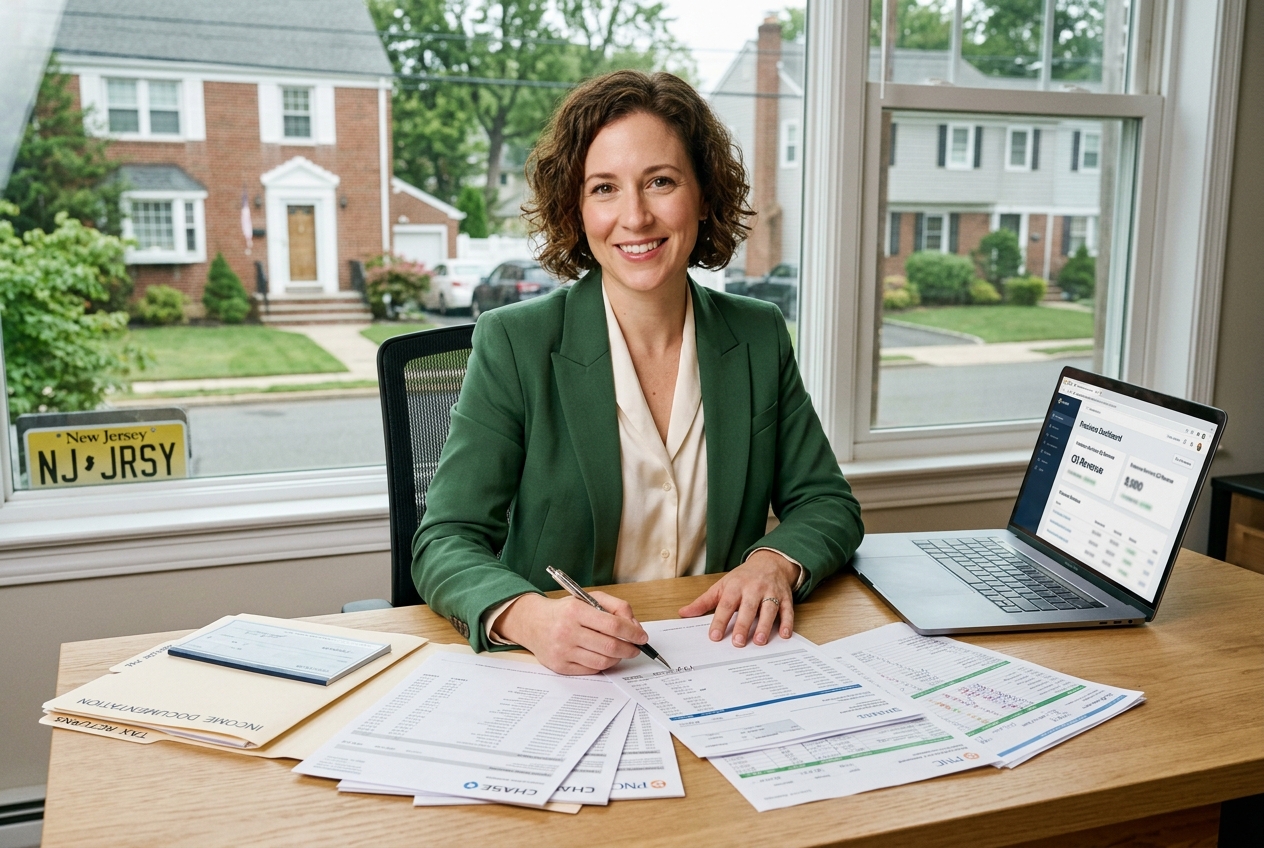
Bank Statement Loans in New Jersey: How Self-Employed Borrowers Can Qualify Without Traditional Income Documentation
For many self-employed borrowers, getting a mortgage is not difficult because the business lacks income. The challenge is proving that income through traditional documentation.
Business owners often reinvest profits, claim legitimate business deductions, or have income that changes from month to month. As a result, tax returns may show less qualifying income than the cash flow moving through the business.
A bank statement mortgage in NJ may offer another path for eligible borrowers. Instead of relying primarily on traditional income documentation, certain mortgage programs use deposits shown in personal or business bank statements to evaluate cash flow.
This guide explains how bank statement loans in New Jersey work, who may qualify, how deposits are calculated, and how these loans compare with conventional and DSCR financing.
What Is a Bank Statement Mortgage in New Jersey?
A bank statement mortgage is a type of alternative income mortgage designed for borrowers who may not fit traditional income-documentation requirements.
Instead of qualifying solely through W-2s and standard tax-return income, an eligible lender may analyze deposits appearing in the borrower's bank accounts over a specified period.
These programs are commonly considered by:
Business owners
Self-employed professionals
1099 workers
Independent contractors
Entrepreneurs
Commission-based professionals
Real estate professionals
Consultants
Medical and legal professionals
Borrowers with complex income
A bank statement loan is generally considered a non-QM mortgage in NJ, meaning it falls outside the standard Qualified Mortgage framework. Non-QM does not mean "no documentation." The lender still needs to verify the borrower's financial ability to repay under the specific program guidelines.
Who Can Qualify for a Bank Statement Loan in NJ?
Bank statement financing is primarily useful for borrowers whose actual cash flow may not be adequately represented by traditional taxable income.
For example, imagine a business owner deposits an average of $20,000 per month into a business account. Their tax returns may show substantially less income after legitimate operating expenses and deductions.
A qualifying bank statement program may analyze those deposits and apply an expense or income factor according to the lender's guidelines.
However, $20,000 in monthly deposits does not automatically equal $20,000 of qualifying monthly income.
The lender may need to determine which deposits represent business revenue, remove ineligible deposits, and account for business expenses.
How Do Bank Statement Loans Calculate Income?
This is one of the most important parts of the process.
A lender may review 12 or 24 months of bank statements and calculate eligible monthly deposits. The exact methodology varies by lender and program.
For a business account, an example could look like this:
Average eligible monthly deposits: $25,000
Lender's applicable expense factor: 50%
Estimated qualifying income: $12,500 per month
This is only an illustration. Actual calculations can differ significantly based on the lender, business type, documentation, ownership percentage, and program requirements.
Which Deposits May Be Excluded?
Not every deposit necessarily represents income.
Underwriting may identify and exclude items such as:
Transfers between accounts
Loan proceeds
Large unexplained deposits
Refunds
Certain investment transfers
Non-recurring deposits
Other deposits that do not represent business revenue
This is why maintaining clean, well-documented bank accounts can make the process easier.
12-Month vs. 24-Month Bank Statement Mortgage
Borrowers may encounter both 12 month bank statement mortgages and 24 month bank statement mortgages.
The difference is the period of bank activity used to evaluate income.
12-Month Bank Statement Mortgage
A 12-month program can be useful when a borrower has a strong and relatively consistent recent income history.
It may also reduce the amount of historical financial information that needs to be reviewed.
However, eligibility and income calculations depend on the specific lender.
24-Month Bank Statement Mortgage
A 24-month bank statement mortgage provides a longer history of deposits.
This may be helpful when income varies seasonally or the borrower wants to demonstrate a longer pattern of business cash flow.
A longer history can also reveal fluctuations that underwriting needs to evaluate.
There is no universally better option. The appropriate documentation period depends on the borrower and the available loan programs.
Can I Use Personal or Business Bank Statements?
Potentially, yes.
Some bank statement programs allow qualifying deposits from personal bank accounts, while others may permit or prefer business bank statements.
Business statements can provide a clearer picture of company revenue, but the lender may need to account for the expenses required to operate the business.
Personal statements can sometimes simplify the analysis when business income is regularly transferred into a personal account.
The important point is consistency. Moving money between accounts simply to make deposits appear higher can create underwriting questions rather than solve them.
What Do Business Expenses and Write-Offs Mean?
One major advantage of bank statement financing for some self-employed borrowers is that the program may evaluate cash flow differently from a conventional tax-return calculation.
Traditional underwriting may rely heavily on taxable income after eligible deductions and adjustments.
A bank statement program may instead use eligible deposits and an applicable expense factor.
For example, a contractor might have substantial gross deposits but also significant costs for labor, materials, vehicles, insurance, and equipment. A lender cannot simply treat every dollar deposited into the account as personal income.
The applicable program determines how those expenses are handled.
This is one reason an experienced mortgage professional should review your situation before you assume that bank statement financing will produce a higher qualifying income.
What Credit Score Do You Need for a Bank Statement Mortgage?
There is no single credit-score requirement for every bank statement loan.
Requirements vary by lender, loan size, property type, occupancy, down payment, reserves, and other factors.
A stronger credit profile can generally provide access to more financing options and potentially more favorable terms.
Before applying, review:
Credit history
Existing monthly debts
Available assets
Down payment
Business income
Bank statements
Property type
Occupancy
A mortgage advisor can then determine which available programs fit the complete picture.
How Much Down Payment Is Required?
Bank statement loans do not have one universal down-payment requirement.
The amount can vary based on the lender and the borrower's overall profile. Factors may include credit score, loan amount, property type, occupancy, reserves, and debt-to-income or alternative underwriting criteria.
Some borrowers may qualify with a lower down payment, while other scenarios may require substantially more.
Do not assume that a bank statement loan automatically requires 20% down. Likewise, do not assume that every borrower will qualify with a small down payment.
The lender's specific program guidelines determine the answer.
What Properties Can You Buy With a Bank Statement Loan?
Depending on the program, bank statement financing may be available for different residential property types.
Potential scenarios can include:
Primary residences
Second homes
Investment properties
Single-family homes
Condominiums
Townhomes
Certain multi-unit properties
Eligibility varies by lender.
If you are purchasing an investment property, another financing option may also be worth considering: a DSCR mortgage.
Bank Statement Mortgage vs. Conventional Mortgage
A conventional mortgage is often preferable when a borrower's documented income supports qualification and the borrower meets conventional guidelines.
A bank statement loan may become useful when traditional income documentation does not accurately represent the borrower's financial situation.
Feature | Conventional Mortgage | Bank Statement Mortgage |
|---|---|---|
Income approach | Traditional documentation | Bank deposit-based analysis |
Self-employed borrowers | Yes | Yes |
Tax returns | Often important | May be less central depending on program |
W-2 required | No for all borrowers | No |
Best suited for | Traditionally documented income | Certain self-employed borrowers |
Program availability | Broad | Lender-specific |
A bank statement mortgage is therefore not automatically "better." It is another tool for borrowers who may have difficulty qualifying through conventional documentation.
Bank Statement Mortgage vs. DSCR Loan
These two programs can sound similar, but they solve different problems.
A bank statement loan in NJ generally focuses on the borrower's business or personal cash flow.
A DSCR loan in NJ primarily evaluates the cash flow generated by an investment property rather than relying on the borrower's personal employment income in the same way as a traditional mortgage.
For example:
Self-employed home buyer: Bank statement financing may be worth exploring.
Real estate investor purchasing a rental: DSCR financing may be worth exploring.
The best choice depends on whether you are purchasing a primary residence, second home, or investment property and how the transaction needs to be underwritten.
Advantages and Disadvantages of Bank Statement Loans
Potential Advantages
A bank statement mortgage can offer:
An alternative to traditional income documentation
Flexibility for certain self-employed borrowers
A way to evaluate business cash flow
Potential solutions for borrowers with significant tax deductions
Options for borrowers with complex income
Potential Disadvantages
There can also be trade-offs.
Depending on the program, borrowers may encounter:
Higher interest rates than some conventional options
Larger down-payment requirements
Reserve requirements
Program-specific property restrictions
More detailed bank-statement analysis
Lender-specific eligibility rules
The goal should not be to choose a bank statement loan simply because it sounds easier. The goal is to compare the available financing options and choose the one that makes financial sense.
What Documents Do I Need for a Bank Statement Home Loan in NJ?
Although these loans can reduce reliance on traditional income documentation, they still require documentation.
Depending on the lender, you may need:
12 or 24 months of bank statements
Personal identification
Business documentation
Business license or formation records
1099 forms, when applicable
Profit and loss statements
Asset and reserve documentation
Credit information
Property information
Documentation for unusual or large deposits
The exact requirements vary by lender.
Common Bank Statement Mortgage Mistakes to Avoid
Self-employed borrowers can make the process harder by preparing their finances incorrectly before applying.
Avoid:
Mixing Personal and Business Transactions
Frequent transfers between accounts can make income analysis more complicated.
Making Large Unexplained Deposits
Underwriters may need documentation showing where unusual deposits came from.
Assuming Revenue Equals Income
A business's gross deposits are not automatically the borrower's qualifying income.
Choosing a Loan Before Comparing Options
A bank statement loan may solve an income-documentation problem, but a conventional mortgage could still be more advantageous if you qualify.
Waiting Until You Find a Property
Speaking with a mortgage advisor early allows you to understand your likely options before making an offer.
Is a Bank Statement Loan Right for You?
A bank statement mortgage NJ borrowers consider should be evaluated based on the entire financial picture.
If you are self-employed and your tax returns do not tell the full story, there may be financing options beyond a traditional mortgage.
Virtue Funding LLC is an independent mortgage brokerage based in Hawthorne, New Jersey. Rather than limiting borrowers to one lender's product menu, Virtue Funding compares programs across its lender network, including conventional, jumbo, bank statement, DSCR, FHA, VA, USDA, and other financing options.
That multi-lender approach can be particularly useful for business owners, 1099 workers, investors, and borrowers with complex income.
Final Thoughts on Bank Statement Loans in New Jersey
A self employed bank statement loan can provide an alternative path for borrowers whose business cash flow is difficult to document through conventional income calculations.
The key is understanding how deposits are calculated, whether personal or business statements are appropriate, how expenses affect qualifying income, and how the program compares with conventional or DSCR financing.
There is no single mortgage solution for every self-employed borrower.
Speak with a Virtue Funding mortgage advisor about your specific situation. Virtue Funding can review your income, goals, assets, and property plans, then compare available mortgage programs to help identify options that may fit.
All applications remain subject to lender approval, income and asset verification, appraisal requirements, and applicable underwriting guidelines. Loan programs, rates, terms, and requirements can change.